Department 03 · Shareware and History
The Mac Shareware Era
Before the App Store there was shareware: try first, pay by mail, support by email. What that era gave the Mac, and where it survives.
On this page
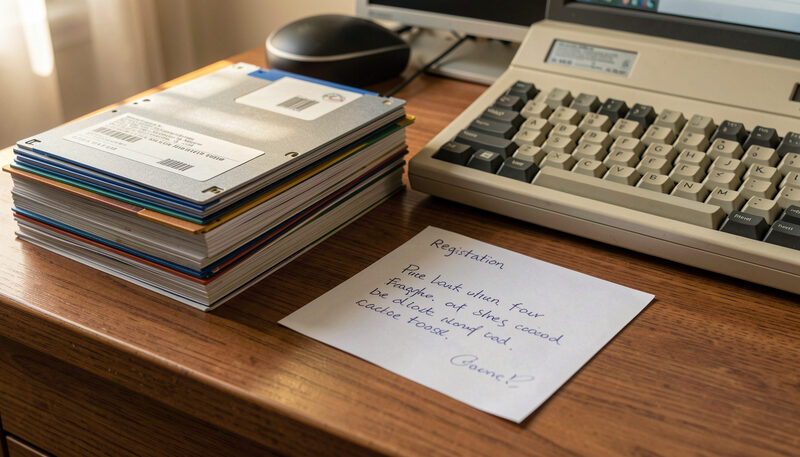
Before software had a store with a capital S, it had an envelope. A program arrived on a borrowed floppy or a modem line, ran for a trial period, and then asked, politely and permanently, for a registration fee to be mailed or faxed to its author. This was shareware, and for roughly two decades it was the way a whole class of Mac software was born, sold and supported, often by a single person answering their own email at night. The model is gone as a mass phenomenon, but its habits, the free trial, the personal licence, the update by download, are so thoroughly baked into how software is sold now that most users meet its ghost daily without knowing it.
What shareware was, and what it was not
The definition was contractual rather than technical. Shareware was copyrighted software distributed freely for evaluation, with payment owed to the author if the user kept it, a try before you buy arrangement enforced by conscience, nag screens and disabled corners rather than by licence servers. It was distinct from freeware, which asked nothing, and from public domain code, which owned nothing. The author kept the copyright and kept the responsibility: the documentation, the support, the roadmap and the invoices all belonged to one address. This personal scale was the model's signature, a word processor or a scheduler or a database browser written, priced, documented and defended by the same individual, and it is why the era's software still carries recognisable voices in its read me files.
How the software travelled
Distribution was the era's hard problem, and its solutions now look archaeological. The great public archives, Info-Mac above them all, mirrored across university servers carried the catalogues; online services such as CompuServe and AOL hosted their own libraries and their own fees; computer magazines sealed cover CDs full of the month's releases inside plastic sleeves; and user groups, the social fabric of the platform, copied disks for members and demonstrated new finds at monthly meetings. A shareware author's release day meant uploading to the archives, updating a version history page, and trusting the mirrors to carry the file outward over weeks. Through those channels a tool written in a Sydney suburb could reach a laboratory in Germany and a classroom in Canada, which was, for its time, a remarkable form of global distribution at almost no cost, and the reason so many one person companies could exist at all.
The money: how a registration worked
The economics ran through payment processors, and the name every shareware user of the nineties remembers is Kagi, a Berkeley company that stood between author and buyer: it accepted the mailed cheques, the faxes with card numbers, the early web payments, took its percentage, and forwarded the rest, sparing ten thousand authors the work of merchant accounts. Registration typically arrived as a code or a file that switched off the nag screens, and fees sat in a band from roughly ten to a hundred dollars, set less by market research than by the author's sense of a fair ask. The Sydney publisher of this domain priced its database browser SyBrowser at 89 US dollars and its scheduler MacAT at 39, both registered by payment, and both quoted here as facts of their day from the archived record. When Kagi closed abruptly in 2009 it took a business model with it; PayPal and the app stores had already rebuilt the rails underneath.
The culture: one author, one address
What the receipts do not show is the correspondence. Support ran on email, answered by the author, often the same evening; bug reports went straight to the person who could fix them, and sometimes did, overnight. Upgrades were posted as free downloads for years at a time, announced on version history pages that read like diaries. Documentation was written in the first person and shipped as plain text. The best of the era's authors kept a personal register that no enterprise vendor has imitated since, and the users responded with a loyalty that looks quaint now: registrations paid years late with apologies, postcards from readers on holiday, forum defences of tools whose authors had never asked for them. Newsletters held the scene together, TidBITS above them all, still publishing, and the whole apparatus cost almost nothing to join, which was the point.
What the era left behind
The App Store's arrival in 2008 did not kill this world so much as pave it, but its survivors carried the tradition across. Some names from the shareware years are still shipping on the Mac today: BBEdit, born 1992, is the oldest living example; Panic, born 1999, grew from shareware utilities to a studio with its own hardware. Around them the indie Mac scene kept the personal scale, direct sales from the developer's own site, a licence that feels owned rather than rented, release notes written by hand, and it added modern conveniences, the subscription bundles and update feeds, on top of foundations the shareware era poured. The free trial that every user now assumes is the era's most universal inheritance, normalised decades before it was standard elsewhere in software. And the habit of judging a tool by its author's responsiveness, which shareware users learned out of necessity, remains the sharpest test a small publisher can be put to, as the evaluation checklists in Software and Tools still recommend.
How to read the record today
The documentary record of the era is unusually good, because the software and its descriptions were meant to be copied freely and the public web archives kept catching them. The Internet Archive's Macintosh software library preserves the discs themselves, catalogue listings and read me files included, and the Wayback Machine holds the product pages of thousands of small publishers, prices and version histories intact. The story of this domain is one worked example of that record: a one person Australian software house reconstructed entirely from archived pages, its catalogue, its prices and its twenty year copyright lines. The SyBrowser retrospective and the MacAT scheduler history show the same method applied to single products, and the heritage section exists to keep applying it, in the era's own spirit: facts first, nostalgia afterwards.